Join us in our public Facebook Group, where we will discuss these issues.

Saturday, February 27, 2021

Gift Economy or Obligation Economy?


What is the Gift Economy? To put it into simpler terms, its an exchange between people isn’t with tangible goods under certain conditions, but rather given as gifts without explicit agreements or future rewards.

Some examples would be video gamers receiving donations while they stream, or people who use Only Fans to generate money through donations. But is there such thing as a gift transaction without the obligatory feeling of having to give a gift in return or continue giving gifts to our favorite influencers? Another question to ask is how much does the gift economy build community between fans and companies/influencers?

Photo by Donald Tong from Pexels

With some platforms, the gift economy may feel more obligatory. For example, anyone can create a Twitch account and stream themselves gaming, and they can receive donations from the people they watch! The same thing goes for YouTubers with paid sponsorships or ads that are set to play during their videos. If you watch the ad all the way through, then they receive a donation from that ad.

Another way that influencers get a larger outreach would be from their fans! Above is a picture of Naruto cosplayers. The reason I wanted to tie cosplayers into the idea of the gift economy is because they are inadvertently helping/giving to the franchise they love! When others see a picture like this, and they’re interested in the reason behind their costumes and poses, they may look into the Anime itself, giving it more viewers. But there is a flip side that all too many fans have experienced.

The Social Exchange theory basically says that if the costs of the relationship are higher than the rewards then that relationship has to end. Some institutes with a large fan base and influencers find that their fans are valuable, in more than one way. Some followers of popular movie or TV show fandoms like to create their own spinoffs of their favorite characters, but this may come with a cost. If their spinoff gains popularity online, then they may get sued by the original show/TV series. This caused a quarrel between the Gift Economy Theory and an Instrumental relationship.

This circumstance requires a fan, who has made many gifts to their beloved fandom, to pay a fine over their recreation of their passion. This brings ethics into the equation. Are our gifts actually optional or do they come off as obligatory?

Photo by Polina Sirotina from Pexels

The gift economy can make you feel guilty. Plain and simple. Take churches for example, they have aa large following and support group, but at the end of the day we have to remember that they have employees to pay for their services too. So churches my pass donation plates around after a sermon about giving and helping one another. This altercation can make gift giving feel transactional, so is it still a gift? Or take one of my previous examples of Only Fans. This app allows people to pay subscriptions to certain individuals for explicit pictures. Some view this as a gift, but some people rely so heavily on these subscriptions and donations that they use it as a primary source of income. When one of their followers unsubscribe or fail to make a payment, it could be devastating to them, causing the donor to feel guilty for failing a direct line of contact.

So, what is the gift economy? Its not so simple after looking at it all. The gift economy exists in certain situations, but everyone views transactions differently, therefore there are different theories behind it.

4 Types of Cultural Practices

         Did you know there are 4 types of cultural practices in our societies that are practiced online? This last week of February and much of playing catch up game due to the crazy winter storm in Texas, we learned about these 4 types of cultural practices that we have seen throughout our lives. If you do know about them, then please keep reading and share your thoughts in the comments below!

To start off, there is emergent. Like the name, this is when something or someone emerges out of nowhere! For example, thinking about my old days, Justin Bieber kind of came out nowhere and took over many girls time and money! Looking further back, the group The Beatles has the same affect. They came out of nowhere and were there to stay. Lastly, a more recent example that can be considered emergent is the popular app, Tik Tok. This app took off steadily throughout the pandemic of 2020. Many who were stuck at home because of quarantine, sought out to Tik Tok for entertainment to pass the time.  Either to create their own content or just sit back and enjoy the ride. There is no pressure of being active and creating videos so it truly is an app to pass a good time. 

            The second type of cultural practice is dominant. This one sounds very familiar to emergent in a way. However, the difference for dominant type is that this thing or person(s) takes over every generation mostly. Not just one generation or one age group. An example of this could be the Netflix series, Tiger King: Murder, Mayhem and Madness. This show became very popular at the beginning of quarantine in 2020 among each generation. If you didn’t watch the show then maybe you saw the woman, Carole Baskin, dancing on Dancing with the Stars, on the television. If you didn’t get a chance to see that then maybe you heard the song, Carole Baskin Killed Her Husband, on social media. As you can see, this show and the product of some actions that were done resulted it to spread everywhere. It became a dominant practice for many people from each generation. Another example of dominant was pagers. Before there was even flip phones, the Razor or Blackberry, there was pagers. The younger generation wanted them to look cool and send cool little messages to them. The parents wanted them to communicate it with their jobs and family and the grandparents liked to have them because they were convenient. Pagers became something popular among everyone not just one age group!

            The third one is called residual. When I read this word I think of recycling or rescuable and it kind of lines up with what residual means. Residual means when a generation is obsessed with something from the past and it becomes dominant again. A fashion sense of this that spread was scrunchies, high waisted jeans, mom jeans, crop tops, some tennis shoes like Rebooks, high-top converse, and mid-thigh shorts for males.  Another thing one can think about is video games and specifically Mario Brothers. It launched in 1983, popular for about 10 years or so, died down and came back strong when technology had advanced. Gen X and millennials specifically were excited for this comeback since they experienced its first released and got the experience of the game in a new experience. Lastly, the example the book that we read gave the example of vinyl records. I found this very true as many people especially music lovers enjoy purchasing these. Then there are the people who just enjoy the aesthetic from them and like to decorate a space with a couple of them or a lot of them!

            The fourth cultural practice that we learned is called archaic. This one in the most simple way to say it is, this thing or person is gone, there is no coming back for it. One of the first things that I thought of when thinking of what is archaic from my childhood was group forwarding chain text messages. I don’t know who started them but I would receive this long message of a scary story or something nice like “if you get this message, this person loves you”. Then it would threaten you at the end, “if you don’t send this to 10 or more people, the dead lady will haunt you tonight” or “if you don’t send this to 10 or more people, something bad will happen to you tonight”. It’s a rough draft but I still remember getting them and trying to think of what 10 people I could send them to! Another thing that I thought about was CD players. I don’t see these things coming back at all, even for the aesthetic vibe like vinyl records have to them. It was just something necessary at the time to listen to music on the go or in the car and was just simply replaced by smartphones and Bluetooth. 

            In conclusion, much of these types of cultural practices happen right in front of us and if we don’t pay attention they zoom by right in front of you or come back and give you flashbacks of the past. 

Instagram and the Gift Economy

 This past week, we read part of a book called The Gift. This book by Marcel Mauss talked on how different cultures gave gifts to each other. Some cultures competed with each other on who could give the best gifts, throw the best parties, and host the best ceremonies. We learned about how Scandinavian countries and cultures give gifts called, "contractual gifts". These gifts are given voluntarily and you do not have any obligation to give a gift back in return. But, if you don't give a gift back in return then you will no longer receive gifts from that person. It is a slap in the face to receive a gift and not give one back in return. The Samoans present gifts to each other during marriage ceremonies, childbirth, circumcision's, sickness, and funerals. They give these gifts to show that they care about one another, and that they appreciate the other person. Think about this for a second. Do we do this today to each other? Well, probably not in real life as much. But, this exchanging of gifts can be seen virtually more than anything. Since I see this in Instagram more than any other social media, I'm going to use it as the example to make the comparison. 

To understand how giving and receiving gifts IRL and getting lots of interactions on social media compare, we must first understand why we feel the same way on both occasions. People in general love to give. People like to give because we know that in the future, we may also receive. Whether this be virtually or physically. You may not know it, but every time you are going on an app like Instagram to follow, like and comment on things you are giving a gift. When people like and comment on our posts, it makes us feel the same way it would to receive a gift. The same way you feel on Christmas is the same way you feel when you get a lot of interactions on your post. This is because of a chemical in your brain that naturally releases whenever we receive a notification that correlates when we receive gifts. This chemical is called dopamine. When we get a social media notification, our brain releases dopamine. That dopamine triggers a happiness within ourselves that makes us feel valued. When we feel valued, we want to naturally make other people feel valued. 

Just like how the Samoans present gifts during important life events, we do the same on platforms like Instagram. If a friend of yours posts on Instagram a picture of her engagement ring, you are going to like it. That is your friend, and you want to make her feel valued and show her that you are excited. You might be so excited for her that you even throw a comment out there. "OMG YAS SIS!", or whatever females say to each other nowadays when it comes to that. Depending on how close you and that friend are, she may notice that you didn't like or comment on her picture. Of course, if she is a mature friend she may not think anything of it negatively. She might think you were at work, or somehow accidentally didn't see it. If she is not a mature friend and cares that deeply, she may not like your next post or maybe even unfollow you to show you that she took it personally. As your friend, she was expecting you to post a comment or show her support in front of all her followers. She expected that gift, because she likes and comments on all of your post to do the same to you. People nowadays are starting to find value in how many likes and comments they get on their posts. If you aren't partaking in the value-building of that person, they may not want to show the same back to you. It's basically a matter of "you didn't like my post so I'm not going to like yours", and "you didn't comment on my post so I'm not gonna comment on yours". Sound familiar? In the gift economy of ancient cultures, if you didn't give a gift back after you received then you wouldn't get a gift again. Kind of like if you don't start commenting and liking my post I will not be doing the same to you.

In conclusion, we can see the comparison to apps like Instagram and the gift economy of ancient cultures. Ancient cultures would give gifts to show how much they value another. If you don't give a gift back, you don't show value to them so they excommunicate with you. How scary is that? It's understandable when in ancient cultures if someone gave you a cow and you didn't give anything back how that could be taken the wrong way. But all over a like? Or a follow-back? Not everyone is like this, but I feel in the younger generations it could eventually come to this. The gift economy will continue despite technological advantages. It's just now they get a lot less sentimental. 


The Twitch Gift Economy

                We typically love the idea of gifts, well, except when you feel like you owe someone a gift back because you feel obligated to do it. In some cases, the overused phrase of “giving is better than getting” is true but there is also a twist to that idea that is typically not talked about. Whenever you give something to a friend or give out of generosity even though you have good intentions, selfish implications can be present as sometimes people can use that gift to feel like the bigger and better person. This of course can be on the extreme end of things, but it is important to remember that this is similar to the idea of the gift economy that Marcel Mauss talks about.

                Ok so hopefully, we are not that selfish and do not have the “so, what are you going to do for me now?" toxic mentality, but what we do know is that friendships (healthy ones at least) are built out of mutual respect and understanding. Usually, gifts are the best way to show love for another friend, and that gift is often reciprocated in the form of another gift or even time and effort for something else. This is how a typical physical friendship may work, but how does the gift economy translate into the social media world? This question becomes increasingly intriguing to dissect if one of your relationships is solely based on online interactions and not having that intimate foundation of physically being in the same room as the person you are friends with. We can see this idea prominent in many different forms of social media with one of them being Twitch as one of the biggest examples of the gift economy in action.


                Twitch is an online streaming platform that allows people to go live from the comfort of their home and it allows them to do numerous activities ranging from ASMR, gaming, chatting, and so on. This platform has become increasingly popular since its release and many people enjoy watching their favorite streamers with who they build relationships. These relationships are built on the foundation of an audience member to performer not unlike how a concert goer watching their favorite band member only that it is online and often times become more personal. For a world dealing with a pandemic, this is a great solution to the boredom of staying home all day and avoiding people in public. So, what exactly does this have to do with the gift economy? Well, Twitch has its own form of an economy that is separated into two parts: subscriptions and bits. These are what streamers rely on to make money for their time and effort put into streams, which is a lot more than many people realize.

                This is the type of hobby that can turn into a job as you can imagine, yet many streamers feel uncomfortable when asking for donations or subscriptions even at that because many of them claim that they are simply doing it for fun. There are still of course many streamers who have no problem asking for these things (and might even be really rude about it), but a good majority of streamers seem to hate to ask for people to give something to them. Some of the bigger streamers even cap their donations or take donations off entirely to avoid missing out on reading a donation or feel weird about it. But why is this an issue? Receiving money is something that we would all be excited about is it not? Not necessarily. From Mauss’s point of view, we create a dynamic through gifts that makes people feel as though now they owe something back in exchange for their generosity. This reminds me of the time I gifted one of my friends a game recently on Steam because I wanted to play it with her and she told me, “No, don’t do that, I don’t have the money to pay you back!”. Even though this was clearly a gift and I was not expecting anything in return, this is the perfect example of how a streamer might feel weird about accepting donations and subs as some of them feel as though they can not pay you back properly.

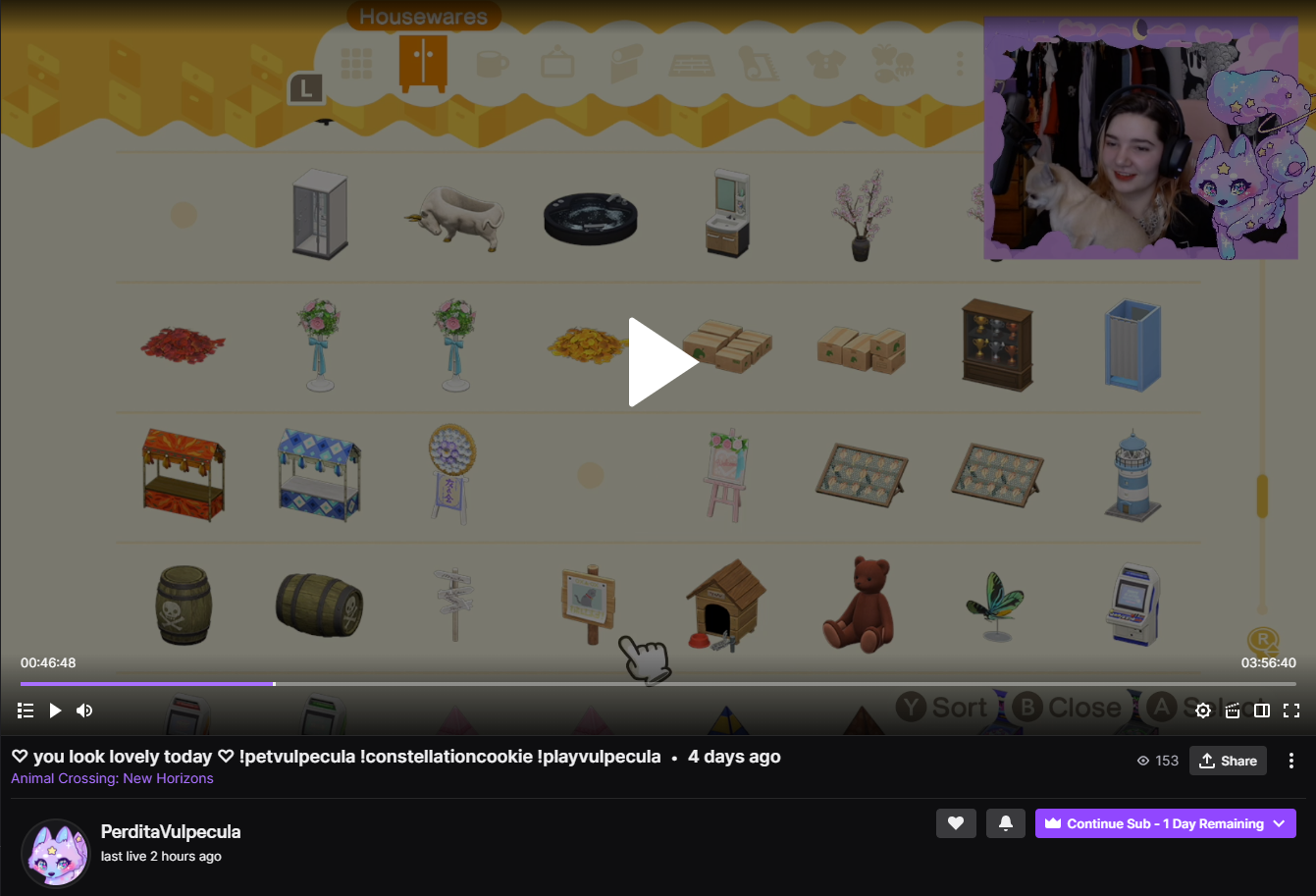
This does not mean that this is a bad economy though and many people are appreciative of the fact that you give them something. One of my now close online friends who goes by PerditaVulpecula on Twitch is one of the sweetest people you will ever meet (y’all should totally follow her) and she is thankful for all of the donations and subscriptions she receives. By the gift economy standards, her content is what we are receiving and in exchange, we are viewing it as time is also a valuable resource on both ends. Sometimes, time can even be more valuable than money in this case as setting up the stream and overlays can take quite a bit of time and of course, the viewer themselves watch the stream for entertainment and for support of that certain streamer. This idea is taken one step further though when donations or subs are incurred. Again, we see this exchange of gifts from one person to another. In Perdita’s case, if someone donates or subs to her, she will then thank them for what they gave her. Subscriptions go one step further as they will receive custom emotes for their subscription for as long as the subscription lasts, thus further extending the gratitude of the streamer like Perdita. In this case, there is a duality of obligation and no obligation present here. Perdita does obviously not have to stream, and she does not have to make emotes for people who are subscribed to her, but she does it because she enjoys spending time with her audience and wants to make sure that they feel appreciated. This is the same concept for the viewer as well; they are not obligated to watch nor are they obligated to give any kind of money, but they do it because they enjoy spending time with her and want to make sure she feels appreciated.

This sort of gift economy is unique as it blends the idea of friendship and celebrity into one. Many viewers see streamers as this amazing individual similar to that of celebrity status but also as a friend whom they can potentially confide into about certain situations. We see that Mauss’s theory still holds to be mostly accurate even in this situation as this sort of relationship is not something we are forced into nor do we feel it to be truly necessary, but it is done out of a social obligation that does not seem so sinister as mentioned in the first paragraph due to the fact that the viewer and streamer feel a genuine human connection present. There are many viewers who donate even without being asked to, which can only be derived from a special type of relationship as in many other cases people are not willing to spend so much money otherwise. This intimacy perpetuates a dynamic that will continue to grow as the number of streamers continue to rise and so do the number of viewers which will then continue this particular cycle within the gift economy.

Friday, February 26, 2021

Social Media Influencers and The Gift Economy

 Hi!!! 

    Welcome back to your favorite blog posts ;) - JK I just thought it would be appropriate to sound like an actual influencer for my introduction. On today's agenda I am going to go deep in the topic of social media influencers and social media in regards to the gift economy

    Whoever is currently reading this post, I want you to think of your all time favorite social media influencer or your current favorite influencer. Questions I have learned to ask myself about these people are - "why do I like this person?", "why do I follow this person?", or "how does this person influence me specifically?". These are all good questions I would have never thought to ask myself, and they are probably questions you may have not thought about either. For starters, I am going to tell you a little bit about my favorite influencer - her name is Kylie Ross. I started following Kylie Ross almost two years ago and I can honestly say I don't remember the specific reason for why I followed her. Kylie used to play soccer at The University of Baylor, which I am guessing is what initially drew my attention to her (because soccer players are dope - ME - I am also a soccer player). Over the last year I have invested a little more time in Kylie's content than I would for most social media influencers. What I really like about Kylie is how authentic she is, she is very raw and honest - which are things that I love most about all people. Kylie and I also have the same interests in fitness, fashion, and we are pretty close in age - which makes it so much easier to relate to her. The next question to ask yourself would be, "how do you actually know when a person is being honest and authentic?" - an example for Kylie would be how she openly talks about her faith and religion, she shares personal information about her relationships, and she is very open in talking about her failures in life. Most influencers that I used to follow were not comfortable talking about religion on their platforms, so when I see an influencer posting their beliefs on social media - I respect that. Also, I feel as if most influencers have a specific way they post which is more "picture perfect" rather than their everyday lives. 

    In regards to social media, the gift economy is a way that people can influence a brand by giving them a better status instead of physically giving them something. An example of the gift economy on social media would be sharing, liking, or commenting on someone's post. Girls do this ALL the time - they will text their friends and say something like "go show my picture some love" (I absolutely hate that >:(). There are times where I do share things for the benefit of someone else, like one of my friends just opened her own online boutique - so as her friend, I gave her a shout out so she could get more followers. That example kinda takes me back to middle school days where EVERYONE would post "shoutout posts'', which I would never have thought of as a "gift". Now let's go back to my favorite influencer, Kylie Ross, something I have caught myself doing is I will watch all of her YouTube videos AND I will like and subscribe to all them. This is weird for me because I am not a Youtube person whatsoever, so the question is "why do I do it"? Obviously the content she is posting is entertaining but I am not gaining anything for myself personally. I have realized that I watch and subscribe to her because I just like her as a person, not really because I am interested in whatever workout video she just posted - meaning I am actually involved in the social media gift economy (MIND BLOWN)!! Another reason that I do this for Kylie is because she is actually one of the few influencers who respond to people's dm's - well maybe not everyone, but she responds to me which makes me feel ~ cool ~. Now I wouldn't say this makes me feel obligated to engage in the social media gift economy, but it definitely makes me feel like I am supporting someone. 

    In today's society, being authentic can be really hard. Personally I feel as if society has grown to be more open-minded, but also way more judgmental at the same time. Building an authentic brand can be hard when you are constantly feeling the pressure of not being good enough or always comparing yourself to others. I know for me it would be hard to receive ugly comments or mean private messages when all you're trying to do is hustle to make a name for yourself. So I guess the next time you're on social media, at least do your favorite influencer a solid and show them a little extra love, or give them a gift I should say ;)!


OnlyFans: The perseverance of a Social economy

*Disclaimer: If sex is a sensitive topic you aren't interested in or easily get offended by, do not read this blog. 

Although the gift economy has oddly revolutionized how our current economy works, monetary value widely depends on the relationship between the 'consumer' (whoever is infatuated into giving money) to the person they feel like deserve these funds. A good example of this behavior is OnlyFans, since although a small part of the money comes from the monthly subscriptions and a big chunk comes directly from tips and personalized requests that customers willingly drop $40-$120 dollars. But why do these consumers choose to drop this amount of money if they could easily go on a site for free? 

OnlyFans Logo

According to a OnlyFans model who currently attends college at Texas State, she says "These requests are personalized, but getting to the point where they agree to spend any money on these requests always starts with building a relationship with the consumer. Many men on my page are lonely men who want to feel special, and I provide this service by doing whatever they want me to do. For a fee, of course". Her statement reflects back onto the gift economy, where the "gift" exchange can only be established after the character of the social relationship has already been established. These online relationships have increased tenfold with the increased use of social media where most of these models promote their pages (Mostly Twitter, due to Instagrams strict nudity guidelines). 

To establish these sort of relationships, OnlyFans workers advise to treat their page as a user democracy by asking their subscribers what they want to see. This begins a social interaction between consumer and seller, but this is only step one to the venture. This is only the tip of the IceBerg for most ventures, since good X-rated pictures don't sell, communication sells. As Business Insider states, running a successful OnlyFans is as much about good communication as X-rated content. From a simple business perspective, if you can't communicate the product or offer a reason to purchase this sort of content. If this is the case, chances are you won't do good in this economy. After all OnlyFans as any business, focuses on Effective business communication since it is essential for success and growth [...] business communication is always goal oriented.

The reason why many businesses rely on Influencers is the same reason why OnlyFans is as successful as it is, the people who purchase the product have a sense of trust which makes the purchase much easier than if they were purchasing a subscription to a X-Rated site. Even though a professional site can provide more content than a consumer could ever need, it's the personalization of content that gives OnlyFans the edge over any other site. This personalization is what greatly shapes the Gift Economy. Prior to the introduction of personalized products into the American market, we relied on a 'Henry Ford' like production line for almost everything (For my Business folk, this is known as Mass Production) to a more diverse production of products that allowed small businesses gain a huge spot in the market due to its ability to focus on smaller, more personalized orders than their big market competitors. 

If there is one concept that the American Economy has taken note of, it's the improvement of sales if the consumer gets what they want, how they want it. This is known as customization, and millennials, in particular, value customization when shopping. Customization first began with Nike and Adidas offering to design any kind of shoe to the consumers taste. This later transformed to personalization, which on the other hand caters to one specifics needs and wants of the consumer which is why many subscribers on OnlyFan pages feel cared about or feel some sort of allegiance to "Their queen" (Or king, depending on the model). With this direct form of communication between subscriber and creator, it's easy to understand why this relationship soon grows into the gift economy that many thrive on.

The gift economy was greatly impacted when actor Bella Thorne, famous from her Disney Show 'Shake it up', charged a mere $20 for what many believed what was going to be sensational X-Rated pictures of their childhood crush. To the disappointment of many, Bella Thorne posted said she would not be posting anything fully nude. More specifically, she said, “Nooooo I’m not doing nudity!!! <3.”. This soon proved to be costly to the more 'Common' OnlyFans worker, since OnlyFans posted a cap on tips due to the amount of refunds requested soon after the seeming betrayal many felt of not seeing what they thought they were paying for. Workers weren't getting the amount they used to, since the bridge between the worker and the 'gifts' was greatly diminished. 

Sunday, February 14, 2021

what is that? "trending"

 We have finally arrived at Unit Two!

๐ŸŽ‰ Woo-hoo! ๐ŸŽ‰ For the first post of this Unit, we will be talking about virality and spreadability. It’s not hard to know what's up with the world, we all know what's trending, either a song, video, dance moves, style, there are infinite things to go viral with, heck since the superbowl the number of memes have increased! ๐Ÿ˜‚ From all this, I want to know your thoughts on what makes you want to share things, either with a few people, close friends, maybe even to the unknown public? Is it “friendship-based” or “interest-based”? ๐Ÿ‘€ What are the feelings you get from sharing something be it political, opinional, or simply for the sake of your personal image -even the tรชte-ร -tรชte it inspires with another.
If you could post one thing to have go viral, what would it be and why do you think something like that would spread far and wide to many other people?

Final Paper, Part 2: Literature Review

hdstsytsdystsutsyt Literature Review Social platform reddit can tell us a lot about the impacts pandemic. For example, Hossu and Pardee ( 20...