Join us in our public Facebook Group, where we will discuss these issues.

Saturday, January 25, 2020

Netflix's "The Circle" Has Mead Written All Over It


In this Netflix adaptation of the British reality show, contestants live in the same apartment building, but do not meet face-to-face. Instead, the contestants have to use their social media personas to charm their way up to the final prize.

After watching the show, it seemed very interesting to me the various choices some of the players made on the show. Obviously, since the players don't meet in person, some chose to use catfishing as their major tactic. In all of these cases, appearance is what drove these decisions. It seemed obvious to them that prettier faces and rocking bodies was the ultimate winning edge that they needed.

The other half of the contestants chose to come as themselves and thought that being "real" was the actual winning statement. But what does it mean to be "real," anyways?

According to the Circle contestants, being real means to be personable, flirty, and funny. But Mead would argue that their definition of "real" is actually obtuse.

Mead's discussion of the self involves the "I" and the "Me". The "Me" is the outcome from other people or environments, while the "I" is the individual's response of the "Me."

In the case of The Circle, the "Me" is the prior knowledge the contestants have of social media coming into the show, and the "I" is the active decisions that contestants make on the show to get ahead with this knowledge.

For the non-catfish contestants, what they believe to be their "I's" is really just their "Me's." Their identity is really just a Franken-self created by the "Me." While they think that they're just being themselves and not being fake, in reality the contestants are conforming to the rules of social media that they learned while using it. 

Arguably, the catfish contestants are more honed into their "I's" than the contestants claiming to be their true selves. The catfishers also conform to the non-explicit rules of social media, but the difference is that they actively chose to do so. Since it is a game, these behaviors could just be merely described as strategy, but really there has to be a sense of "Me" to create a strategy in the first place.

Overall, all of the contestants had a shared knowledge of social media as an environment, and they all used that knowledge to their advantage. Female contestants used relatability and support as a tactic to get closer to other females, and used flirting to get closer to the male contestants. It was the same vice versa, too.

By the end of the show I found myself wondering what I would do if I were a contestant on the show. While catfishing seems like the most self aware choice, I don't think I could stomach pretending to be a different person entirely. Inevitably I think I would chose to play as "myself." 

Whatever the hell that means, anyways.

How Social Media Is Unhealthy

Social media has gotten to the point where all users care about is the amount of likes or views they are getting. Social media apps are corrupting the youth and basically anyone that uses the apps.

Why Do People Care?

Instagram used to be an app where people could post whatever without worrying about what their followers thought of it. As our generation specifically grew up, we started closely monitoring how many likes each of our pictures got and even started comparing to their friends' pictures as a sort of competition to see who was more "popular". The magic number is eleven. That is until Instagram removed the number of likes visible except to the poster. People go as far as to even delete posts that didn't get the desired number of likes. It's me. I'm "people". Well used to be. The obsession over likes and views is corrupting the youth at large.

Why Does This Matter?

Jason Howie
On almost every app there are people who call themselves "social media influencers" who live these lavish lifestyles and make a living just by posting pictures online. These influencers acquire followers in the millions but don't seem honest in their feed. Take for example the Ace family. They have a following of 18 million subscribers who watch and follow the family's life online. Austin and Catherine and their two daughters look happy as can be online, but are they just putting on a front for their viewers? Outrage sparked when viewers were furiously calling to "cancel the Ace family" after Austin was accused of raping someone and forcing them to sign a nondisclosure agreement after the fact. This then caused some trouble with anyone involved and obviously their marriage, yet they still uploaded their weekly videos as if nothing was wrong. The woman who was allegedly raped put out a statement on Twitter commenting that her friend who initiated the story told her they could get paid $100,000 for getting the story to run. Again, he didn't care to bring justice to his friend, he cared about the attention and spotlight that would be broadcast onto them and the pay that they would eventually get. Users of Instagram also follow models who have millions of followers. Most of their feed is them in swimsuits or revealing clothes which is available for anyone to see. The face that these models put out for the public versus what their life may actually be is very different. Many of these girls have eating disorders or have had work done to make their bodies look that good. When viewers see these pictures, it can cast ugly thoughts into their minds that make them think, "I have to look like her to be pretty" or "If I was that skinny maybe I'd get the amount of attention she does". These thoughts are NOT OKAY.

What Else?

TikTok. Oh how I love TikTok. I spend hours upon hours on this addicting app without even realizing it to only check the time and think, "Ah shit, I have a blog post due tonight". Kidding kidding. But really though, TikTok started as an app called Musical.ly. This app was mainly used by younger kids to make weird dance and lip syncing videos. Eventually the app was acquired by Chinese company ByteDance in November of 2017. I think I can speak for most "older" users when I say we downloaded it as a joke and became addicted. How is this app bad you ask? First off, there are no parental restrictions (that I know of) so kids as young as six years old are exposed to adult humor. Honestly, most of the videos I see on the "ForYou page" are very dirty and not something six year olds should be seeing; not like they understand it anyways, but still. Second, the bigger users only care about how many views or likes their videos are getting. Most of the time the views are only shown to the user but the likes on the video are visible to everyone who sees the video. Our own fellow classmate, Aric Vasquez, went viral on one of his videos with 300,000+ views and 10,000+ likes. He went around asking our friends to go like his video so it could boost his number of likes. Another example of no parental controls, yet a hilarious one, is on Facebook. A little girl tells her Amazon Alexa to play "Little Bo Peep Has Lost Her Sheep" but instead gets a song by Lil Dickie... not exactly something a three year old should be exposed to or listening to at her age. Last but not least, another Amazon Alexa incident where a little boy asks for a song called "Digger Digger" but is given a porn station in return. Both videos are pretty funny but still show that modern technology and social media is not giving/setting good examples for the youth.

Even though social media isn't really "healthy" per-say for people, it's still addicting and people will never really follow through with their "social media cleanse". Admit it, we all love it too much.


Everything You Mead to Know

~ The I and Me~


Throughout your everyday life you constantly transition between two different personas. These two personalities are referred to as I and Me by George Herbert Mead.  His interpretations of our societies' multiple personalities shaped the way we study, and interact with other people. I am hoping that this post will help both you and I develop a better understanding of his work. 

~ The Me~ 

The way everyone sees you is your Me. You conform to social norms, are not very spontaneous, and you are in the game to please others. It isn't really you, it's who society wants you to be. When society treats you a certain way you react to receive a better reaction. Your Me tends to come out when you step out into the world, surrounded by people you are simply trying to live out a peaceful life. 

~The I~


In contrast to the Me, the I is your reaction to the Me. We take into account what others have said to us and generate our own thoughts instead of just conforming to society. Our own personal experiences help develop our own standpoints on topics instead of just saying what people want to hear. Your I tends to be more spontaneous however rarely comes out in society. And in some cases becomes entangled with the Me and leads to dissociation within society. 


Cultish Phenomena and What We Can Learn from It

I don’t know about any of you reading this, but cults have always been a huge point of interest for me. I did a project back in senior year of highschool on Charles Manson and the Manson family-and I’ve been intrigued ever since. I remember researching and digging up articles, and all these questions kept nagging my brain. Why do things like this happen? How can one person start something as creepy and complicated as a cult?

 I know that the Manson cult particularly was based on the offering of love, drugs and fame from Charles himself. He was a cruel manipulator who convinced people to murder and become blind to their own actions. I’ve tried to understand the reasoning behind cults and their leaders, but things like this are intricate and scary. When you really analyze a gathering such as a cult, one thing stays in common- a charismatic yet manipulative leader. Anyone who begins a cult has something wrong with them, but the extent of their psychotic nature is covered by their friendly facade. This covers their real nature and expresses that they are an understanding and caring human; when in reality they are manipulative and ill-Intentioned.


-This is supposed to represent people following a leader I guess-

There was a documentary on Netflix that explained why cults grow and develop, but it was only like 20 minutes. However, it did cram a lot of interesting information that made me realize that cults aren’t just a spontaneous occurrence- they form because the people that fall into them are at a crossroads with themselves and feel like they have nowhere left to run. This hopelessness releases a feeling of loneliness that means whoever is experiencing it will do anything to reverse it, so they find comfort in cults- believing that they are actually a new and freeing religion of some sort. What would you do if you were in a position that held no hope? If an opportunity for redemption and ultimate freedom presented itself- would you take that chance? I’d like to believe I’m mentally stronger than those who give in- but when there’s nowhere left to run, I think people would grasp for any small opportunity for happiness.

Anyone would like to believe that they would know a cult when they see one, but when you look at Jonestown- Jim Jones has everyone completely convinced that they should kill them selves to ascended another plane or some crazy stuff. This was over 400 people. It’s hard to believe everyone would so willingly take their lives, but when involved in something like this, people become blind to the obvious symptoms of a cult. Of course, cults have a facade that gives the impression of a safe and homely environment, but when they are analyzed- they are seen for what they truly are. A complicated and manipulative charade that makes whoever believing in them blind to the fact that they are degrading and essentially evil.


There are ways to connect this with a theory, and I want to try and connect this idea with Mead’s ideas. If we look at the “me” side of Mead’s ideas, cult leaders are disconnected with what others think about them. I personally see them as a void of human emotion, only wanting to better themselves and their causes. Narcissistic. If (the majority of them) had any shred of empathy, they wouldn’t have had the power to demean their own fellow people. So in a sense, I don’t think leaders of cults have an idea of “me”. They don’t think that other people’s views matter and they will do whatever they can to advance themselves. From a Mead perspective, I’d say that their personality is strictly abiding to the “i”. Their ego is what drives them to be such emotionless people.

Once I talked to my grandfather about the cult world and he gave me an interesting point of view. Note that my grandfather majored in psychology during college, and had always had an affinity for the mind. We got to talking about the darker side of psychology and I mentioned people like Charles Manson and Jim Jones. I asked my grandfather what he thought of them and he countered with a deep question. “What makes them like that?”. I had no idea how to carry on the conversation. I offered the
 idea that they had family troubles growing up, but lots of people on Earth have family problems and still carry on normal lives. What makes these people different? I think that only the future will tell us. We can estimate and make theories on why people make the choices they make, but ultimately, everyone is different. We can pry and question the people who create their fearsome cults, but it’s hard to determine what the motive is for these people.

To conclude, I want to talk about a book I read during highschool. “The Sacred Lies of Minnow Bly” was a book about a girl raised in a cult. Although completely fictional, it taught me a strong lesson that humans are very naive and hopeless creatures when at a stalemate in their lives. Minnow was a girl who grew up in the forest with a cult. She was seen as guilty for opposing the marriage of the cult’s leader, and had her hands cut off as punishment. The story carried on with her being excommunicated from the cult and having to discover life on her own. The entire story was very moving and I’d definitely recommend reading it.


It’s difficult to decipher what exactly leads to a cult and why their leaders are so deceptive, but with time, I’m sure there is much more to learn and uncover. I hope we can further understand and possibly prevent these issues from occurring, and learn from the past as we further our knowledge.


Why do we care about likes so much?

In today’s society, the older generation does not understand why the younger generations acts the way that they do. There are times where I am still confused on some of the things that kids do these days. Something that has stood out to me during our talk in class as well as on the internet was why is it that kids care so much about how other people view them and how many likes they can get on their posts. As much as people say that they don’t care about what people think about their post, they definitely do. I am a victim of doing so. I think as a grew older, I care more and more about the amount of likes I have been getting on my posts and when I don’t get enough then I wonder if it is because I look bad in the photo, or people are just hating.


After reading an article by Grazia that goes into depth about how we care so much and what we see as millennials posting on any form of social media. When Instagram first became an app and everyone started to use it, people didn’t care or understand what everything meant. 11 is the magic number. Once you were able to hit 11 likes, it displayed the specific number of people they had double tapped on your picture. Everyone posted a pic on Instagram just so they could get AT LEAST 11 likes. We often tell everyone that we know to like our pictures no matter what it is, they did not have to even read the caption, just double tap the screen so it has a bigger number at the bottom of the screen. We also find ourself monitoring our likes very closely so that we know weather to ask more people or be excited that we got a certain number of likes. People tend to try to tweet or post something that a lot of other people are thinking so that it is so relatable that everyone has no choice but to agree with you and like it. The thing that Should make us worry is that as growing adults in our 20’s there are far more important things that should be a concern. Many of us need to worry about what job we are going to have, where we are going to live, school, family, and many grown up things like that. The like button was introduced to the world famous Facebook in 2009 sometime and thus changed how we all see social media. We have become so used to the like button being involved in social media that it seems as we can only see it that way. It is hard to see social media without a button that shows that you are any bit of interested in the content that is being posted. The article states that Facebook alone has totaled 1.13 trillion and 3.5 billion new likes everyday. This shows how much we love to press that little heart button. Although this all may seem very strange and out of the ordinary, it’s not! Human beings are people that simply need love. We are very much social animals and this has been this way for a very long time. We enjoy the acceptance of other humans and this is why it’s called social media. It is a concept of many people coming together and showering affection or hate to Each other Behring the screen. Not everyone is going to like what you post. There are many different personalities in people around the whole world that will enjoy different things than you, so people will relate to different things. There are also people that simply don’t care about people’s approval or likes and these people are the ones that seem to be “mentally mature.” Studies say this because 60% of university students say that it affects their confidence when they don’t get enough likes and also could cause mental health problems could hurt the development of the country.  Some people go to the extreme to delete the picture that they had posted just because it did not get enough love as they thought it would. Instagram has now made a new feature where they hide the number of likes from anyone that sees the picture except you so that everyone can be equal. Seriously? That’s what this world has come to? Unbelievable. In my opinion, I think that this problem is only going to stay the same and if not, get worse. As we get older people seem to get more sensitive about content being put out there and people are just going to start caring more and more about the way they look to other people more than how they look to themselves. Social media has ruined us but I still love it, lol.

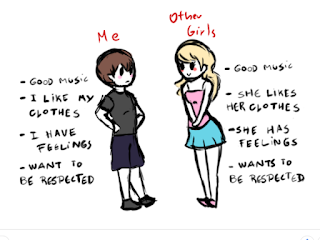
Social Meadia: "I'm not like other girls"


Are you the “cool girl” or are you the “other girl”?  Or maybe you’re the guy that told a girl “you’re not like other girls, you’re cool!”.

Social media has drawn us further away from the “I” and has emphasized our relationship to the “me”. What the hell does that mean? Well… let ~Mead~ tell you!  

American philosopher George Herbert Mead theorized that our interactions and socializations with others influences how we think about our-“self”. This idea of “self” toggles between what he names the “me” and the “I. The “me” is the cultivated idea of “self”. It’s the unique recipe of experiences and social interactions that makes up how we think of ourselves. It’s the part of you that internalized that “you’re not like other girls” comment from your middle school crush. Whereas the “I” is who you really are, your soul, your ego, your internal “self”.

It’s safe to say that this idea of “I’m not like other girls” developed in the pre-social media world. It is nearly innate to human nature to compare ourselves to one another. Whether it is in pre-social media world or the social mediatized world, this phenomenon happens purely out of a place of understanding the “me”. With the convenience of social media, we have the ability to compare ourselves to others at the palm of our hand.

The internalization of external interactions of the “me” has taken on a whole new level through maintaining a social media identity. Where societies interactions were subjective to people’s immediate environment, it is now open to endless amounts of virtual interactions through our online identity.

Girls can relate to the phrase “not like other girls”, because that’s what that one person said 10 years ago or we feel this way based of our own comparison to others. 

We all know that girls are expected to behave and look a certain way. Our interactions with others and pop culture shapes this idea of traditional femininity. This shared ideology of what a woman or girl is supposed to look like is cultivated by our socialization with other women. As individuals we take all of these external factors in and reflect them as our “me”. The trope of “normal girls” and “other girls” derives from the rejection of these stereotypical gender roles.

If a girl doesn’t fit into the generalized standards of what it “is” to be girl, then they are categorized as the “other”. Essentially, this gets solidified to “not like other girls’ = good and “other girls” = bad. Many of these types of memes are from the perspective of the “other girl”. So, instead of feeling like an outcast as the “other girl”, they chose to own it and identify with it as a part of their “self”. Kinda, sounds like a good thing, self-acceptance am I right?

When posts are made by the self-deprecating perspective by the “other girl”, it can be understood as the “I” breaking off from the “me” and claiming ownership to their identity. However, since one is just adapting to the identity that others gave them, then it is more of an illusion of finding the “I” than anything else. The true “I” seems to be nearly unreachable in this case.

Then a sksksksskand I oopTik Toc came along. What use to be  #Notlikeothergirls  memes escalated to videos and the generalization of different types of girl broadened to VSCO girlsE-Girls, and SoftGirls. This platform makes #Notlikeothergirls in parody videos where the “other girl” is like every other girl. In other words, the “normal girls” take ownership in being the “other girl”.

Wait, I thought the “other girl” = bad? Now the "cool girls" are rebelling against the "other girls" rebellion against stereotypes?

What happens to the “other girls” self-worth when it has become nothing but a parody? I don’t have an answer for it. However, you would expect it to depreciate but on the other hand, maybe it become oddly liberating that their whole identity is trending as a parody and that’s what “the cool girls” are doing now.

So who's the "other girl" now? That's right, there is no "other girl".

The problem is that we all want to fit in but we also want to stand out and these are very contradictory goals.

Where societies interactions were subjective to people’s immediate environment, it is now open to endless amounts of virtual interactions. The internalization of external interactions of the “me” has taken on a whole new level through maintaining a social media identity.

This inevitably pulls people away from having a relationship to their "I" and creates obsession over fulfilling the "me".

Girls nor boys should be generalized to be one or the other. There is not just one or the other. We can wear sneakers one night and heels the next.  So, stop telling your middle school crushes “you’re not like other girls”. Obsess over finding your "I", whatever that means to you.


You All Have a Little "Me" in You

Ever wonder what it would be like to create a whole new persona online that you could essentially do with whatever you’d like? Well, guess what.. You already do. According to Daily Mail.com , “over 75% of people admit to making their lives more exciting on social media”. Is this because we absolutely enjoy the thrill of knowing we have just lied to the ENTIRE world about who we are and what exactly we do? Or … is this because, although we hate to admit it, we value other people's opinions of us. 

 You Catfish!
To some, the word ‘catfish’ is the name for an aquatic animal with weird little whiskers, but for much of the internet it means someone who is attempting to draw other people in with a completely fake social profile. There was an entire show over trying to find the real people behind these fake profiles called (wait for it) Catfish. Who would’ve guessed right? This show has EIGHT seasons of two men doing research and finding the faces behind the screen. That’s a lot of faking if you ask me. If we are following the data from above, would that make over 75% of people even a little bit of a Catfish? No, not exactly but it includes the same concept. This is not the only show that has been created following the idea of a fake profile. There is a show on Netflix called “Circles” where a group of people create a profile. They can choose to make a completely fake profile or, they can make one as true to character as possible. The goal of this game is to be the most popular profile by the end of the week and the most popular profile wins. Games and shows are created around the idea that faking part of our social profiles makes us more likeable. 

If we truly take a look around, the amount of effort we put into this desire to be liked and retweeted and shared and commented on, is hilarious. One morning while I was at work, my coworker and I were having a serious debate about which picture she should post on her Instagram when she suddenly blurted out “Wait! I don’t even know why I'm posting right now. It's too early, no one will see it anyway. I’ll post it at like 10 or 11 instead..” I was more than confused when she mentioned this and I had just enough curiosity to ask why. Her reply was elaborate and way too long to  put on here but to summarize, according to this oh-so-popular high school girl, people don’t scroll far enough to see the early morning posts so you have to do it at the average time that your peers wake up. The amount of effort she had already put into debating the PERFECT picture to post was a lot for me to deal with but now, timing? Does she really think about every single aspect of posting a picture in order to maximize the amount of feedback she will receive on one post anyway?

The Science Behind the Fish
I've always thought the amount of time and effort that we put into creating a semi interesting profile that we want everyone to notice was narcissistic as heck but after the past week, I have a slightly different outlook on this topic. A man by the name of George Herbert Mead is the mastermind who figures it’s just who we are! He believes there are two concepts that we exist with, the “I” and the “me”. The “I” is how we see ourselves and the “me” is how we think others see us. The me is also called the social self because we respond according to our social norms in a given situation.  Has it become the social norm to change who we are on social media to be liked? In the show Catfish, the concepts of the I and the me can get a bit confusing. I think the reason that people create fake accounts like that is because they value the me part of themselves more than they do the I. As for my coworker, I don't think the situation is as severe but it still requires the same concept. The hunger to be liked or be approved of by others on social media is a driving force behind the majority of the things being posted. We create an entirely new identity, one that we think reflects how others view us and accept that as a social norm. We all know we take a lot of time thinking about how to post a certain picture, what angle, what lighting, what filter. For what? The reassurance that we are doing life right in the eyes of our peers. 

The society that we live in now is heavily influenced by the me but imagine how much more the me was used 100 years ago. 200? Even though a lot of what we do today is driven by the me, the I is used more than ever in my opinion. We have difference resources now to display how much we value others opinions but we also accept self expression just as much. Fishy as it seems, the me in everyone is socially constructed and will be valued by every individual differently but will always impact how we live our daily lives.


Final Paper, Part 2: Literature Review

hdstsytsdystsutsyt Literature Review Social platform reddit can tell us a lot about the impacts pandemic. For example, Hossu and Pardee ( 20...